
The serve starts before you touch the shuttle.
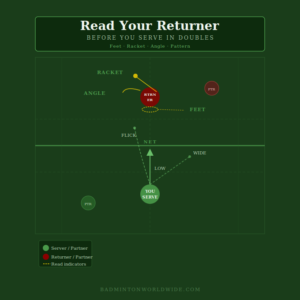
Most competitive doubles players think about the serve from the moment they pick up the shuttle. The grip, the stance, the target. But the players who consistently win the serving battle start reading the situation a full five to ten seconds earlier — before they’ve even set their feet.
Learning to read your returner before you serve is a skill. And like every skill in badminton, it can be trained. Here’s what to look for.
Foot Position: The First Tell
Before anything else, look at where your returner is standing and how their feet are oriented.
A returner standing close to the short service line with their weight slightly forward is primed to attack. They expect your low serve and they’re ready to pounce on it. Against this player, a well-disguised flick serve becomes your most dangerous weapon — they’ve committed forward and a shuttle going over their head forces a scramble.
A returner standing deeper, with weight more neutral or back, is comfortable waiting. They’re giving you the low serve and trusting their ability to push or lift from a controlled position. Against this player, your low serve needs to be exceptionally precise — tight to the tape, landing short — because they have time to set up their return.
A returner positioned wide of center is telling you the straight serve is open. Whether intentional or habitual, that gap down the center line is an invitation. Take it.
What to watch:
- Heels up or flat — heels up signals attack readiness
- Distance from the short service line — closer means they expect low
- Body angle — turned slightly crosscourt or straight on
Racket Position: What They’re Preparing For
After foot position, look at where the returner is holding their racket.
A high racket — held at chest level or above — tells you they’re anticipating a low serve and preparing to intercept early. This is an aggressive return stance. A flick serve or a wide push to the body can disrupt this completely, because it forces them to change their racket trajectory mid-motion.
A low racket — held at waist level or below — suggests they’re comfortable with a drive or push return. They may be less prepared for a quick net return that dies short. Your most precise, tape-hugging low serve is the right call here.
A racket held centrally with a relaxed grip usually indicates an experienced returner who is deliberately staying neutral to avoid telegraphing their preference. These players are harder to exploit through racket position alone — you’ll need to combine all three reads together.
Body Language and Habit Patterns
Over the course of a match, returners develop patterns they’re often unaware of. Your job is to notice them before they do.
Does this player always push straight when receiving from the right court? Do they instinctively lift when you serve wide? Do they default to a crosscourt return under pressure? These aren’t random — they’re grooved responses built over years of play.
The first few points of any match are data collection. Don’t just focus on winning those rallies — focus on what the returner does instinctively when they’re not thinking. That instinct is what you’ll exploit in the third game when the pressure is highest and their habits take over.
Patterns worth tracking:
- Preferred return direction from each service box
- Response to flick serves — do they panic or are they comfortable?
- How they handle a serve to the body versus a wide serve
- Whether they become more conservative when under pressure or more aggressive
Using What You’ve Read
Reading the returner only matters if you act on it. Here’s how to translate each read into a serving decision.
If they’re leaning forward and their racket is high — go flick or wide body serve. Disrupt the forward momentum they’ve already committed to.
If they’re standing deep and relaxed — go tape-tight low serve. Make them move forward to a shuttle they weren’t expecting to have to reach for.
If they’re positioned wide — go straight down the center line. Don’t overthink it. The gap is there, use it.
If they’ve shown a pattern — break it at the moment it matters most. Save your pattern-breaker for a critical point, not a throwaway rally early in the game.
The Serve Is a Conversation
The best doubles servers aren’t just executing a technique — they’re responding to information. Every returner gives you something to work with before the shuttle ever leaves your racket. The serve itself is your answer to what they’ve told you.
Train the technical side until it’s automatic. Then use the mental space that frees up to start reading. That combination — clean execution plus intelligent targeting — is what separates a good serve from a winning one.
Want the Full System?
If you want to go deeper on serve selection, returner archetypes, and the complete doubles serving framework built around these principles, the Doubles Serve Mastery guide covers all of it in detail.