
The serve isn’t a formality — it’s your first tactical move.
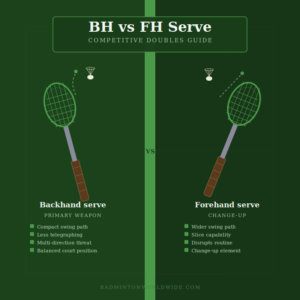
If you’ve played competitive doubles for any length of time, you already know this. Yet most players default to one serve type out of habit rather than strategy. The real question isn’t which serve is better. It’s which serve gives you the most control over the rally from the very first shot.
Here’s a breakdown of both options from a competitive doubles perspective.
The Backhand Serve: Why It Dominates Competitive Doubles
The backhand low serve has become the standard at every level of competitive doubles, and for good reason.
The grip is compact and the swing path is short, which means less telegraphing. Your opponent gets very little read time before the shuttle leaves your racket. From a deception standpoint, the backhand serve also allows you to threaten multiple directions — straight, crosscourt, or a flick — from the exact same stance and preparation.
The other advantage is court positioning. Serving backhand from near the center line keeps you balanced and ready to cover your half of the court immediately after the serve. You’re not caught mid-rotation like a forehand serve can leave you.
For doubles specifically, the backhand serve gives your partner more predictable coverage assignments because your post-serve position is consistent.
When the backhand serve is the right call:
- Against aggressive returners who want to attack early
- When serving from the center or slight side-court position
- When you want to disguise a flick threat alongside your low serve
The Forehand Serve: Still Relevant, But Situational
The forehand serve in doubles gets dismissed too quickly. Used correctly, it remains a legitimate weapon — particularly because most competitive opponents have dialed in their backhand serve return and may be less comfortable with a well-executed forehand low or flick.
The forehand serve also generates different shuttle flight characteristics. A forehand low serve with slight slice can hug the tape in a way that’s genuinely difficult to attack cleanly, forcing a lifted return rather than a flat drive.
The weakness is preparation time and stance. The forehand serve requires a wider stance and a longer backswing, giving your opponent more cues to read. At high competitive levels, experienced returners will pick up on your grip and body angle before you’ve even started your swing.
When the forehand serve has an edge:
- As a change-up when opponents have grooved their backhand return response
- Against returners who stand very wide, leaving the center line exposed
- When you’ve specifically practiced forehand serve deception and feel confident in your disguise
The Grip Sequence Is Everything
Here’s what most serve guides miss entirely: the serve type matters less than the grip sequence leading into it.
For the forehand serve, the key is establishing your grip early without revealing your intent. Moving through your grip stages — from early shaft contact to your bevel position to your final trigger — in a fluid, unhurried motion is what separates deceptive serves from readable ones.
A rushed or tense grip transition telegraphs the serve before the swing even begins. Opponents at competitive level are watching your wrist and fingers, not just your racket face.
This is why drilling the grip sequence in isolation — away from the court, in front of a mirror — pays dividends that pure court practice doesn’t. Once the sequence is automatic, deception becomes natural rather than forced.
The Practical Answer for Competitive Doubles
Use the backhand serve as your primary weapon. Build your serving game around it. But don’t abandon the forehand serve entirely — keep it sharp enough to deploy as a genuine change-up two or three times per game.
The returner who has only seen your backhand all match will be slightly off-balance the first time you switch. That slight hesitation is often all you need.
The best doubles servers aren’t one-dimensional. They have a primary serve they trust completely, and a secondary serve they can execute cleanly under pressure. That combination is what keeps returners honest and gives you control of the rally before it even starts.
Want to Go Deeper?
If you’re serious about building a complete doubles serve system — including grip sequences, court positioning, and serve selection against specific returner archetypes — check out the Doubles Serve Mastery guide available in our coaching store.