
Topspin in badminton serving is one of the most underused weapons at the competitive level.
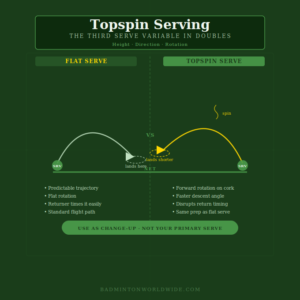
Most players focus entirely on shuttle placement and serve height. Fewer think about rotation. Yet the players who have learned to apply topspin to their serve — even subtly — gain a measurable edge in how the shuttle behaves after it crosses the net, and how difficult it becomes to attack cleanly.
Here is what topspin actually does to a badminton serve, and why it deserves a place in your serving toolkit.
What Topspin Does to the Shuttle in Flight
A shuttle with topspin applied rotates forward along its flight path — cork leading, feathers trailing, with the entire shuttle spinning in the direction of travel. This forward rotation does two things that matter to you as a server.
First, it accelerates the shuttle’s descent. A topspin serve that clears the net by the same margin as a flat serve will land shorter — closer to the short service line — because the rotation pulls it downward faster. This means you can serve with a marginally higher net clearance for safety, while still landing the shuttle in a tight, difficult-to-attack zone.
Second, it affects the shuttle’s behavior at contact. When your opponent strikes a shuttle with forward rotation, the feathers interact differently with their strings than a flat shuttle does. The return tends to come back with less clean transfer of power, often producing a slightly mistimed or softer return — exactly what you want when you’re trying to force a weak reply.
Topspin vs Flat vs Slice: Understanding the Difference
A flat serve travels on a straight trajectory with minimal rotation. It is predictable and consistent, which is why it is the default for most players. The shuttle does what physics says it should do, and an experienced returner can time it reliably.
A slice serve applies sidespin or underspin, causing the shuttle to drift or dip laterally. This is harder to control consistently but can produce awkward angles, particularly on a wide serve that moves away from the returner’s body.
A topspin serve sits between these two. It is more controllable than slice, more deceptive than flat, and when executed cleanly it produces a serve that looks like a standard low serve but behaves slightly differently at the moment of contact — arriving faster to the floor and with subtle rotation that disrupts the returner’s timing.
How to Apply Topspin to the Forehand Serve
Topspin on a badminton serve comes from the brush of the strings across the cork at contact. The key is in the wrist and grip sequence leading into the strike.
For the forehand serve, the topspin motion requires the racket face to approach the cork from slightly below and behind, with the strings brushing upward and forward across the base at the moment of contact. This is a rolling wrist motion — not a full swing — and the contact window is very short.
The grip plays a critical role here. A grip that sits too far into the palm restricts the wrist freedom needed to generate the brush. A grip that positions the bevel correctly — with the index finger providing directional control and the thumb anchoring — allows the wrist to roll through cleanly without breaking down the swing path.
The amount of topspin you apply scales with how aggressively you roll through the cork. A subtle roll produces a serve that looks almost identical to your flat serve but lands a fraction shorter. A more pronounced roll produces a visibly faster descending serve that is harder to time but also harder to execute consistently under pressure.
Key technique points:
- Strings contact the cork from below, brushing upward and forward
- Wrist rolls through at contact — not before, not after
- Grip bevel position must allow full wrist freedom
- Contact point is at the base of the cork, not the feathers
- Keep the swing path compact — topspin comes from rotation, not swing speed
Topspin on the Backhand Serve
Applying topspin to the backhand serve is more challenging because the backhand grip naturally produces a different contact angle. However, a subtle forward roll is achievable with the correct thumb placement and wrist position.
The backhand topspin serve requires the thumb to push through the handle at contact while the wrist supinates slightly — rotating the forearm so the strings brush across the cork rather than pushing straight through it. The result is a backhand low serve that drops slightly faster than your standard flat backhand, with the same deceptive preparation.
This is an advanced technique and should only be introduced once your standard backhand serve is fully automatic. Attempting topspin on the backhand before the base serve is grooved will simply introduce inconsistency without the tactical payoff.
When to Use a Topspin Serve in a Match
Topspin serving is most effective in two specific situations.
The first is against returners who have calibrated their timing to your flat serve. If an opponent has been returning your low serve comfortably for several rallies, introducing a topspin serve disrupts their timing reference point. The shuttle arrives at the floor faster than they expect, and the return quality drops.
The second situation is when you need a margin of safety over the net without sacrificing placement. The topspin serve’s faster descent means you can clear the net tape with a slightly higher trajectory and still land short — reducing your tape error rate without giving the returner a attackable height.
When not to use it:
- When your base serve mechanics are not yet automatic
- When you are fatigued — topspin requires precise wrist control
- As your primary serve — use it as a change-up, not a staple
The Bigger Picture: Rotation as a Serving Variable
Most doubles players think about serve variables in two dimensions — height and direction. Topspin adds a third variable: rotation. When your opponent cannot be certain whether the serve arriving at them is flat or spinning, they face a more complex read. That uncertainty, even slight, is enough to reduce their attack quality.
The serve is the one shot in badminton where you have complete control. You choose when to strike, how to grip, and what rotation to apply. Using that control to introduce a variable your opponent hasn’t prepared for is not a trick — it is strategy.
Build Your Complete Serving Arsenal
If you want to develop topspin serving as part of a complete doubles serve system — including grip sequences, serve selection against specific returner types, and the full Two-Serve framework — the Doubles Serve Mastery guide covers every component in detail.