
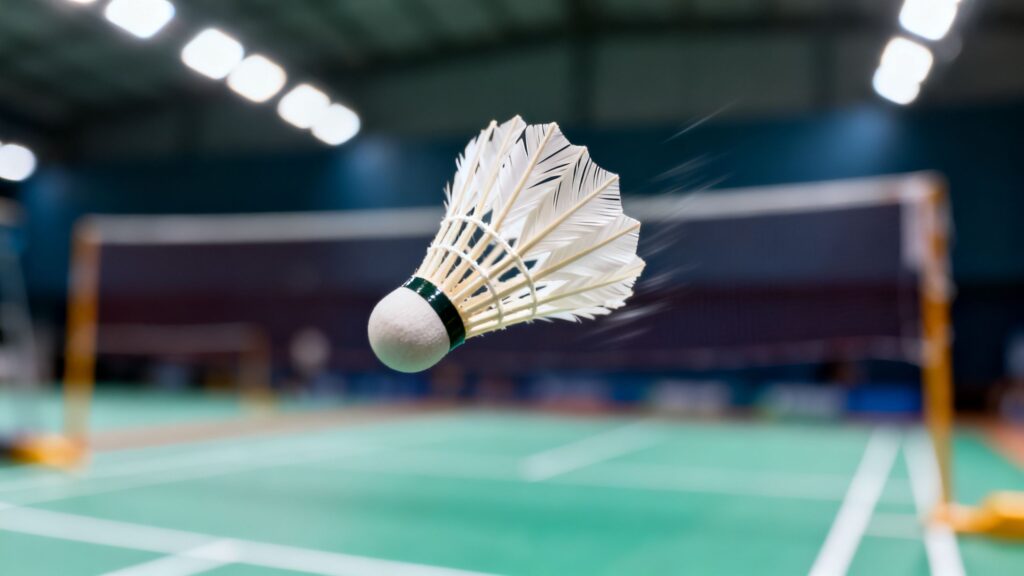
A good low serve in doubles isn’t just low — it’s dying. You want the shuttle to skim the tape and then fall away steeply into the front of the service court, so your opponent has to reach up and lift it rather than step in and kill it. A flat serve that carries even slightly gives a sharp receiver the half-second they need to attack. A serve that dips takes that half-second away.
There are two spins that create this drop: topspin and slice. They get there by different mechanics, they feel different in the hand, and they suit slightly different situations. Here’s how each one works and when to reach for it.
The topspin dip
The topspin dip is created by brushing the racket face up and over the cork through contact — a small forward-and-up rolling action across the base of the shuttle. That forward rotation makes the shuttle tumble on the far side of the net and dive down faster than gravity alone would pull it.
The payoff is a clean, aggressive drop. Because the spin does the work of bringing the shuttle down, you can serve with a touch more margin over the tape and still have it fall away before the receiver can pounce. Even a receiver who reads the serve struggles to get on top of it, because the shuttle is actively diving as it arrives.
The one thing topspin asks of you: a firm contact. The rolling brush needs a responsive string bed and a stable racket face to impart real rotation. Serve it too high or let the face wobble at contact, and the dip flattens out. Keep it low and keep the brush compact.
The slice dip
The slice dip comes from brushing across the shuttle rather than over it — the face cuts laterally through the base and feathers at contact. This puts spin on the feathers themselves, and a spinning shuttle flutters and drops rather than floating on cleanly.
Two things make the slice worth having. First, the dip here comes from feather spin, not from the string bed — which means it works on almost any racket and string setup, not just a stiff, firm rig. If you’re borrowing a racket or playing on unfamiliar equipment, the slice travels with you. Second, the flutter is genuinely deceptive: the wobble makes the exact landing spot and the timing harder to read, which is especially useful against a receiver who likes to creep forward and gamble on the net.
The trade-off is that a pure sliced serve doesn’t penetrate quite as sharply as a well-struck topspin dip against opponents who beat you with reach or anticipation. It’s a deception-and-availability tool more than a raw pressure tool.
Which one, when?
Think of the topspin dip as your primary dipping serve when your equipment is dialled in and you want maximum downward pressure — it’s the harder serve to attack even when the opponent sees it coming.
Reach for the slice dip when you want deception over a net-creeper, or when you’re not on your usual rig and need a dip that doesn’t depend on a firm string bed. It’s the reliable fallback that goes everywhere.
Most strong servers end up with both in the bag: topspin as the default, slice as the change-up and the travel-safe option. Practise them as a pair, keep the contact low and the brush short on both, and your low serve stops being something the other side can attack — and starts being something they simply have to lift.