
Most serving problems in doubles are not what players think they are.
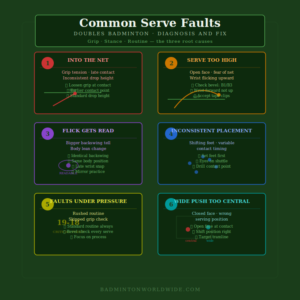
A server who clips the tape assumes the problem is swing path. A server whose flick gets read every time assumes the problem is timing. A server who double-faults under pressure assumes the problem is nerves. In most cases, the root cause is elsewhere — in the grip, the stance, or a preparation habit that has gone unexamined for years.
Understanding the actual source of your serve fault is the only way to fix it permanently. Here are the most common serve faults in competitive doubles and exactly what to do about each one.
Fault 1: Serving Into the Net Repeatedly
The most common serve fault at every level. The server clips the tape or drives the shuttle into the net, and the instinctive fix is to swing higher or aim above the tape. This usually makes things worse.
The real cause is almost always one of three things.
The first is grip tension. A tight grip at the moment of contact restricts wrist freedom and causes the racket face to close slightly, angling the strings downward. The shuttle follows. The fix is to consciously relax the grip during the swing — firm at setup, loose through contact.
The second cause is late contact. If you are striking the shuttle below the optimal contact point — too far forward in your stance or with your wrist already past neutral — the racket face is inevitably angled toward the net. Move the contact point slightly earlier in the swing arc and the trajectory lifts naturally.
The third cause is shuttle height at drop. If you are dropping the shuttle lower than usual before contact, the geometry of the swing changes. Standardize your drop height — release the shuttle from the same point every serve — and the contact point becomes consistent.
Fix:
- Loosen grip tension through the contact zone
- Move contact point slightly earlier in the swing
- Standardize shuttle drop height on every serve
Fault 2: Serving Too High — Giving the Returner an Attack
A serve that clears the net by too much is an invitation. At competitive level, any shuttle above net height at the service line will be attacked. The server knows this, yet high serves remain one of the most persistent faults in club doubles.
The most common cause is fear of the net. After clipping the tape a few times, the subconscious corrects by pushing the shuttle higher — which eliminates the net fault but creates a more damaging one. The serve is now consistently attackable.
The second cause is an open racket face at contact. If the thumb is not correctly anchored at the appropriate bevel — B1 for backhand serves, B3 for forehand — the face opens and the shuttle climbs. Check bevel position before every serve session.
The third cause is too much wrist in the wrong direction. A wrist that flicks upward rather than forward at contact sends the shuttle on a climbing trajectory. The wrist motion for a low serve should be forward and compact — not upward.
Fix:
- Accept occasional net clips as the price of serving low — do not overcorrect upward
- Confirm thumb bevel position before each serve: B1 for BH, B3 for FH
- Keep wrist motion forward and compact, not upward at contact
Fault 3: The Flick Serve Gets Read Every Time
A flick serve that the returner anticipates is worse than no flick at all — it hands them an easy smash from the back court. If your flick is being read consistently, the problem is almost always in your preparation, not your execution.
The most common tell is backswing length. A flick serve requires a longer wrist travel than a low serve, and many players unconsciously take a bigger backswing when preparing to flick. An experienced returner sees the backswing extend and moves back before the shuttle has left your racket.
The second tell is body lean. Players who lean slightly forward into a low serve and straighten up for a flick give the returner a postural cue that is just as readable as the backswing. Keep your body position identical across both serves.
The third tell is grip tightening. Some servers tighten their grip noticeably when preparing to flick — the extra tension needed for the snap shows up as a visible hand adjustment. Work on generating the flick from a relaxed grip with a sharp late snap rather than a pre-tensioned squeeze.
Fix:
- Keep backswing length identical between low serve and flick
- Maintain the same body position and lean for both serves
- Generate flick power from a late wrist snap, not pre-tensioned grip
- Practice both serves in front of a mirror to check for visible tells
Fault 4: Inconsistent Placement — The Serve Lands in Different Spots Each Time
A serve that sometimes lands short, sometimes mid-court, and sometimes wide is not a deceptive serve — it is an uncontrolled one. Placement consistency is the foundation of the serving game. Without it, neither the anchor serve nor the wide push creates a reliable dilemma for the returner.
The most common cause of inconsistent placement is an inconsistent serving stance. If your feet shift position between serves — even slightly — your swing arc changes and the shuttle lands in a different zone. Set your feet before picking up the shuttle and do not move them until after the serve is complete.
The second cause is variable contact timing. If you sometimes contact the shuttle early and sometimes late in the swing arc, the direction and trajectory will vary. Drill a consistent contact point — the same moment in the swing, the same wrist position — until it is automatic.
The third cause is looking at the target instead of the shuttle. It sounds counterintuitive, but servers who look at their intended landing zone during the swing lose sight of the shuttle at contact and lose precision as a result. Focus on the shuttle through contact, trust your practiced swing path to deliver it to the target.
Fix:
- Set feet before picking up the shuttle — do not adjust stance mid-routine
- Drill a consistent contact point until it requires no conscious effort
- Keep eyes on the shuttle through contact, not on the target
Fault 5: Serving Fault Under Pressure
A server who is reliable in practice but faults repeatedly at critical points — 19-all, game point, after a long rally — is experiencing a pressure fault. The serve itself is not broken. The process around it is.
Pressure faults almost always originate in the pre-serve routine. Under stress, players rush. They pick up the shuttle quickly, skip their normal grip check, set their feet carelessly, and serve before their mind and body are synchronized. The fault is the inevitable result of a compressed routine, not a technical breakdown.
The fix is a standardized pre-serve routine that is non-negotiable regardless of the score. Pick up the shuttle the same way every time. Find your bevel position deliberately. Set your feet. Take one breath. Then serve. The routine is what separates a reliable server from one who faults when it matters most.
The secondary cause of pressure faults is target-consciousness — thinking about where the shuttle needs to land rather than executing the motion that puts it there. Under pressure, shift your focus from the outcome to the process. The swing, the contact, the wrist — not the landing zone.
Fix:
- Develop a standardized pre-serve routine and follow it on every single serve
- Never skip the grip check — find your bevel position deliberately every time
- Under pressure, focus on process not outcome: swing, contact, wrist
- Simulate pressure in practice — serve at 19-all scenarios deliberately
Fault 6: The Wide Push Lands Too Central
The forehand wide push loses its value if it does not land wide enough. A wide serve that lands in the middle third of the service box gives the returner a comfortable angle and enough time to recover position. The dilemma the Two-Serve System creates depends on the wide push being genuinely wide — close to the sideline tramline.
The most common cause is an insufficiently open racket face at contact. For the forehand wide push, the strings need to be angled toward the sideline at the moment of contact. If the face is too square — pointing straight ahead — the shuttle travels forward rather than wide.
The second cause is serving from too central a position. The wider your serving position within the service box, the more natural the wide angle becomes. A server standing at the center service mark has to manufacture the wide angle entirely through racket face. A server standing slightly toward the right service boundary gives themselves a geometric advantage for the wide push.
Fix:
- Open the racket face slightly toward the sideline at contact for the wide push
- Adjust serving position slightly toward the right boundary to open the wide angle naturally
- Target the sideline tramline specifically — not just “wide” — in practice
One Common Thread
Almost every serve fault in doubles traces back to one of three root causes: grip position, stance consistency, or a compressed pre-serve routine. Fix those three things and most technical serve problems resolve themselves. The swing, the contact, the trajectory — these are downstream of the fundamentals. Get the fundamentals right first.
Build a Fault-Free Serve
The complete serving framework — including grip mechanics, stance, pre-serve routine, and the full Two-Serve System — is covered in the Doubles Serve Mastery guide. If serve faults are costing you points in competitive doubles, that is where to start.