
A single serve, no matter how good, eventually stops winning points.
This is one of the most consistent patterns in competitive doubles. A player develops a strong backhand straight push — low to the tape, centerline, difficult to attack. It works for a game, sometimes two. Then the returner adjusts. They move a half-step toward the center, recalibrate their timing, and what was once a pressure serve becomes a routine ball they handle comfortably.
The serve hasn’t gotten worse. The returner has simply solved it.
This is the fundamental problem with a one-serve game, and it is the reason the Two-Serve System exists.
What the Two-Serve System Is
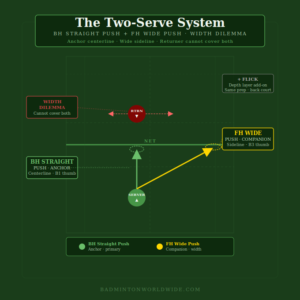
The Two-Serve System is a doubles serving framework built around two complementary serves that create a problem the returner cannot solve with a single positional adjustment.
The anchor serve is the backhand straight push — low over the tape, directed straight down the centerline to the front corner. It is the serve you rely on most heavily, executed from the backhand grip with the thumb anchored at B1, and developed to the highest level of consistency. The anchor serve is your foundation. Everything else in the system depends on it being reliable.
The companion serve is the forehand wide push — also low, also controlled, but directed out wide to the sideline rather than straight down the center. It is served from a forehand grip, typically with the thumb at B3 for moderate deception, and targets the wide service box to pull the returner away from their central position.
Together, these two serves create a width dilemma. To cover the backhand straight push, the returner must position centrally, close to the centerline. To cover the forehand wide push, they must shift wider, covering the sideline angle. They cannot cover both positions simultaneously. The Two-Serve System forces them to choose a position — and punishes whichever choice they make.
Why the Width Dilemma Works
Position is everything in doubles return. A returner who stands centrally can intercept the straight push comfortably but leaves the wide angle exposed. A returner who shifts wide to cover the forehand push leaves the centerline open for the anchor serve to find its target undisturbed.
Unlike a low-versus-flick dilemma — which is primarily about timing and depth — the Two-Serve System dilemma is about court geometry. The distance between the centerline target and the wide sideline target is enough that no single standing position covers both effectively. The returner is always slightly out of position for one of the two serves.
This geometric advantage compounds over a match. As the returner tries to shade toward the center, your forehand wide push finds space. As they correct wider, your backhand straight anchor reclaims the center. Neither adjustment fully solves the problem — it simply shifts which serve is more dangerous on any given point.
Why One Serve Alone Loses Points
A returner facing only your backhand straight push has one task: position centrally and wait. Over several rallies they dial in the timing and return direction. Your anchor serve stops being a pressure point and becomes a predictable starting condition — one they have already solved before the shuttle leaves your racket.
What you lose is not just the serve itself. You lose the initiative. When the returner is comfortable, they dictate the early rally. Your partner is immediately on the defensive. The first three shots — which in competitive doubles almost always determine the outcome — belong to the opposition.
A backhand straight push without a wide serve threat is a gift. You are telling the returner exactly what is coming and giving them the positioning to respond optimally. Even the most precise anchor serve becomes manageable once the returner knows there is no alternative to guard against.
The Mechanical Requirement: Similar Preparation
The Two-Serve System works best when both serves are difficult to distinguish in preparation. The backhand straight push and the forehand wide push are served from different grip orientations — backhand at B1, forehand at B3 — so they will never be fully identical in setup. However, the serving stance, body position, and shuttle hold should be as consistent as possible across both serves to minimize the information available to the returner before contact.
The grip change between serves is the primary tell to manage. A server who visibly rotates their grip from backhand to forehand before serving gives the returner advance warning of the wide push. Working to make this transition compact and late — or disguising it within your normal pre-serve routine — is what separates a readable two-serve game from a genuinely deceptive one.
The goal is not perfect deception — the geometry of the two serves creates the dilemma regardless. But the harder you make it for the returner to read the grip transition, the later they must commit to a position, and the more effective the system becomes.
Adding the Flick
The backhand straight push and the forehand wide push form the core of the Two-Serve System. But a third option — the flick serve — adds a depth dimension on top of the width dilemma.
A returner who has settled into a position to manage the two low serves and moved slightly forward to intercept them early becomes vulnerable to a flick delivered over their head to the back tramline. The flick does not need to be used often — its value lies in its threat. A returner who knows the flick is possible must hold slightly deeper and give the low serves more room to land, which in turn makes the anchor and wide push even harder to attack.
The flick is not the system. It is the layer that makes the system complete.
How to Build the System in Practice
Start with the anchor serve. Your backhand straight push must be consistent enough that you can place it reliably to the centerline target without conscious effort. Until the anchor is automatic, adding the wide push introduces instability rather than dilemma.
Once the anchor is grooved, develop the forehand wide push as a distinct serve with its own consistency standard. Practice it from the same serving position and the same pre-serve routine as the anchor. The wide push must be genuinely low and genuinely wide — a serve that lands mid-court or close to center gives the returner too much time and angle to recover.
Then practice the two serves in combination. Alternate in random sequence — anchor, wide, anchor, anchor, wide — without establishing a pattern. The point at which you introduce the wide push during a match should feel unpredictable to the returner and unremarkable in your own preparation.
Practice sequence:
- 20 backhand straight push serves to the centerline target
- 20 forehand wide push serves to the sideline target
- 40 combined serves in random sequence — no fixed pattern
- Add a training partner to give live feedback on readability and placement
When to Deploy Each Serve in a Match
The anchor backhand straight push is your primary serve — used on the majority of service points throughout the match. The forehand wide push is deployed selectively, introduced early enough to establish its threat but not so frequently that it becomes predictable in its own right.
Use the wide push when the returner has committed centrally — particularly after a run of successful anchor serves has drawn them toward the centerline. A returner who has positioned to cut off the straight push is most exposed to the wide angle at that moment.
Return to the anchor after the wide push has done its work. The returner will adjust wider. The centerline opens again. The system resets.
Save a well-disguised wide push for a critical point — 19-18, or at game point — when the returner is least likely to have prepared for a serve they haven’t seen recently. The psychological pressure of a high-stakes point reduces adaptability, and that is exactly when the system’s geometric advantage is most decisive.
The Bigger Picture
The Two-Serve System is not a trick. It is a recognition that serving in doubles is a tactical conversation, not a mechanical exercise. The anchor and the wide push create a court geometry problem that no single returner position can solve. The flick adds a depth threat on top. Together they give you control of the serving conversation from the first shot of every rally.
One serve gives the returner one problem to solve. Two serves from a consistent preparation give them a problem they cannot fully solve at all.
Learn the Complete System
The full Two-Serve System — including serve mechanics, grip positions, court positioning, and match application against different returner types — is the foundation of the Doubles Serve Mastery guide. If you are serious about owning the serving game in doubles, that is where to go next.