
Ever wondered about the exact lines and spaces that make up a badminton court? The badminton ground size matters more than you might think, shaping how the game is played. Whether you’re just starting out in your backyard or aiming for a competitive edge, knowing these dimensions is key. This guide breaks down all the official measurements, explains what each line means, and even gives tips on setting up your own court. Let’s get into the nitty-gritty of where all the action happens.
Key Takeaways
- An official badminton court measures 13.4 meters long and 6.1 meters wide for doubles, and 13.4 meters long by 5.18 meters wide for singles.
- All court lines, including boundaries and service lines, are typically 40mm wide and are crucial for defining valid shots and serves.
- The court is divided into specific service areas, with different dimensions for singles and doubles play, affecting where serves must land.
- Adequate clearance space around the court, usually at least 2 meters, is important for player safety and freedom of movement.
- Indoor courts offer a controlled environment ideal for professional play, while outdoor courts present challenges like wind and uneven surfaces but are more accessible.
Understanding Badminton Ground Size: Official Dimensions
When you watch badminton, especially at a higher level, you might notice how much ground players cover. It makes sense, right? The court size is actually pretty specific, and it matters a lot for how the game is played. The official measurements are set by the Badminton World Federation (BWF) to keep things fair and consistent everywhere.
Regulation Court Length and Width
The total length of a badminton court is always the same, no matter if you’re playing singles or doubles. It’s 13.4 meters long. The width, however, changes depending on the game type. For doubles, the court is wider at 6.1 meters. But for singles, it gets a bit narrower, coming in at 5.18 meters wide. These lines are usually marked with a 40mm wide line, often in white or yellow so they stand out.
Total Court Area Calculation
So, what does this mean in terms of total space? For doubles, with the 13.4m length and 6.1m width, you’re looking at a total area of about 81.74 square meters. For singles, it’s a bit less, around 69.45 square meters (13.4m x 5.18m).
Singles Versus Doubles Court Dimensions
The main difference you’ll see between a singles and doubles court is the width. The doubles court uses the full width, including the outer sidelines. The singles court, on the other hand, uses an inner sideline, making the playing area narrower. This means players in singles have less space to cover side-to-side, while doubles players have more court to defend. It really changes the strategy of the game, doesn’t it? You can find more details on these court measurements.
It’s interesting how a few meters can make such a big difference in how a sport is played. The court isn’t just a boundary; it’s an active part of the game, dictating player movement and strategy.
Key Court Markings and Their Significance
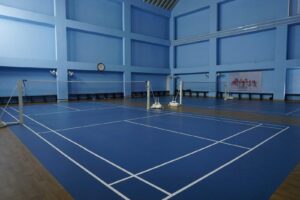
Alright, so we’ve talked about the overall size of the badminton court, but what about the lines themselves? They’re not just there to look pretty; these markings are super important for how the game is actually played. Think of them as the rulebook drawn right onto the floor.
The Crucial Role of Boundary Lines
The boundary lines are pretty straightforward – they tell you where the court ends. For doubles, the court is wider, so you’ve got those outer sidelines to worry about. But when it’s singles time, things get a bit tighter. The singles sidelines are drawn inside the doubles lines, making the playing area narrower. This means players have to be more precise with their shots. A shuttlecock landing on any line is considered in play, which is a key detail to remember. It’s all about knowing if that little white bird landed inside or outside those lines. You can find more details on the specific measurements for singles sidelines here.
Understanding Service Area Lines
These lines are all about where you have to serve the shuttlecock. You’ve got the short service line, which is pretty close to the net, and then the long service line. For singles, the long service line is the very back boundary of the court. But for doubles, it’s different – the long service line for doubles is actually a bit in from the back boundary. This creates a smaller service box for doubles. It’s a bit confusing at first, but it makes sense when you see how it affects the serve.
The Center Line’s Function
This line runs right down the middle of the court, splitting it in half lengthwise. It’s mainly used to divide the service areas. When you serve, you have to hit the shuttle over the net and into the service box diagonally opposite yours. The center line helps define which side of the court you’re serving into. It’s also important for players during rallies, as it helps them position themselves on their side of the court.
The lines on a badminton court aren’t just decorative; they are functional elements that dictate the flow and fairness of the game. Understanding their placement and purpose is key to playing correctly and strategically.
Here’s a quick rundown of the main lines:
- Baselines: The back lines at each end of the court.
- Doubles Sidelines: The outer boundary lines for doubles play.
- Singles Sidelines: The inner boundary lines used only for singles matches.
- Center Line: Divides the court lengthwise, separating the left and right service courts.
- Short Service Line: The line closest to the net that defines the front boundary for serves.
- Long Service Line (Singles): The back boundary for singles serves and rallies.
- Long Service Line (Doubles): A line closer to the baseline, used only for doubles serves.
Getting these lines right is pretty important if you’re setting up your own court. You can check out some tips on setting up a court if you’re curious.
Essential Court Zones for Gameplay
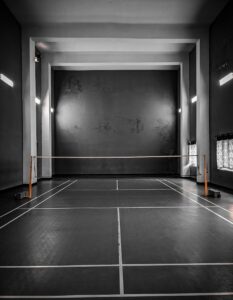
Beyond the basic boundary lines, a badminton court is divided into specific areas that are vital to gameplay. Knowing these zones helps players understand positioning, serving rules, and strategy. It’s like having a map for the game!
Defining the Singles Service Area
The singles service area is a long, narrow box. It’s marked by the center line, the singles sideline, the short service line, and the baseline. When you’re playing singles, this is the zone you’re concerned with for serving and receiving. It demands precision and accuracy.
Navigating the Doubles Service Area
Things get a bit different for doubles. The doubles service area is wider and shorter than its singles counterpart. It’s defined by the center line, the doubles sideline, the short service line, and the long service line for doubles. This wider space means different strategies come into play, and players need to cover more ground horizontally. Understanding these boundaries is key to making legal serves and returns in a doubles match. You can find more details on court dimensions at official badminton court dimensions.
The Importance of the Net and Net Posts
The net is the obvious divider, but its height and placement are specific. The top of the net should be 1.55 meters (about 5 feet 1 inch) high at the sidelines. It dips slightly in the middle, reaching 1.524 meters (around 5 feet) at the center. The net posts sit right on the doubles sidelines, keeping the net taut and at the correct height. These posts are pretty important for maintaining the integrity of the net during play. The short service line, which is 1.98 meters (6.5 feet) from the net, is also a critical marker for serves in both singles and doubles. For doubles serves specifically, there’s also a long service line, which is 0.76 meters (2.5 feet) from the baseline.
Knowing the exact placement of these lines and understanding how they create different zones for singles and doubles play is more than just knowing the rules. It directly impacts how you move, where you stand, and the types of shots you’ll attempt. It’s the foundation for developing effective strategies on the court.
Here’s a quick rundown of key lines and their roles:
- Baselines: The back lines at each end.
- Sidelines: Outer lines for doubles, inner lines for singles.
- Center Line: Divides the court in half lengthwise.
- Short Service Line: Marks the minimum distance a serve must travel.
- Long Service Line (Doubles Only): Defines the back boundary for doubles serves.
Getting these zones right is pretty important if you’re setting up your own court. You can check out guides on how to mark out a court properly to make sure everything is accurate for your games. Playing on a correctly sized court, whether it’s for singles or doubles, makes a big difference in how the game feels and plays out. It’s all part of the game’s integrity.
Safety and Playability: Clearance Space Considerations
When you’re setting up a badminton court, whether it’s for a serious tournament or just some backyard fun, you can’t forget about the space around the lines. This area, often called clearance space, is super important for keeping everyone safe and letting players move without bumping into things.
Recommended Clearance Around the Court
Think of this space as a buffer zone. It gives players room to chase down shots that go wide or long, and it prevents nasty collisions with walls, fences, or other players who aren’t on the court. For official play, there are specific recommendations. Generally, you’ll want at least 1.5 to 2.0 meters (about 5 to 6.5 feet) of clear space extending out from the boundary lines. Behind the court, especially where players might retreat to hit a lob, it’s a good idea to have even more space, maybe 2.5 meters (around 8 feet).
Impact of Clearance on Player Movement
Having enough room to move freely makes a huge difference in how you play. If the court feels cramped, you’re going to hesitate. You might not dive for a shot or stretch out fully because you’re worried about hitting something. This hesitation can lead to missed shots and, worse, injuries. A good amount of open space around the court means players can focus on the game, not on their surroundings. It allows for quick footwork and aggressive play, which is what badminton is all about. It really helps with player circulation and safety.
Avoiding Common Setup Mistakes
One of the most common errors people make is not leaving enough space. They might mark out the court perfectly but forget that players don’t just stay within the lines. Another mistake is not considering what’s beyond the lines – is it a wall? A busy walkway? You need to account for that. Also, make sure the ground in the clearance area is relatively even and free of obstacles. You don’t want someone tripping over a stray rock while trying to save a point.
Proper court setup isn’t just about the lines; it’s about creating an environment where the sport can be played safely and effectively. This means thinking beyond the immediate playing area and giving players the freedom to move.
Here are a few things to keep in mind:
- Measure twice, mark once: Always double-check your measurements for both the court and the clearance zones.
- Clear the clutter: Remove any objects, furniture, or debris from the surrounding area.
- Consider the environment: If you’re setting up outdoors, make sure the clearance space is safe and doesn’t lead directly into hazards like roads or water features. For indoor setups, ensure there’s adequate space before walls or other structures, aiming for at least 1.5 to 2.0 meters on the sides and more at the back.
Indoor Versus Outdoor Badminton Court Environments
When you think about playing badminton, you probably picture a nice, clean court inside a gym. And for the most part, that’s where the serious stuff happens. Professional matches are always played indoors, and there’s a really good reason for that: control. Inside, you get a consistent environment, free from all the unpredictable stuff that nature throws at us.
Advantages of Professional Indoor Courts
Indoor courts are the gold standard for a reason. The biggest win is the absence of wind. Seriously, even a tiny breeze can send a lightweight shuttlecock flying in directions you absolutely didn’t intend. This means you can actually plan your shots and trust them to go where you aim them. Plus, the lighting is usually top-notch, with no harsh sun glare or weird shadows to mess with your vision. You can track that little white bird perfectly, no matter where it is on the court. The flooring is also a big deal. Most indoor courts use sprung wooden floors or special synthetic mats. These are designed to be a bit forgiving on your joints, absorbing some of the impact when you jump or land. They also give you good grip, which is super important when you’re darting around trying to return a smash.
Challenges of Outdoor Badminton Play
Playing outside is fun, don’t get me wrong. It’s way more accessible – you can set up a net in the backyard or at the park. But it comes with its own set of headaches. The weather is the main culprit. Wind is the enemy of outdoor badminton. It makes rallies unpredictable and can really frustrate even experienced players. Then there’s the sun. Glare can make it impossible to see the shuttlecock, especially when it’s high in the air. You might find yourself squinting or having to guess where it’s going to land. The surfaces are usually different too – think concrete, asphalt, or even grass. These aren’t as kind to your knees and ankles as a proper indoor floor, and they can be uneven, leading to slips or trips. Because of this, people often use tougher, plastic shuttlecocks outdoors because they hold up better and aren’t as easily blown around. It’s a different game, for sure.
Surface Material Differences
Let’s talk surfaces for a second. Indoors, you’re looking at wood or vinyl. These are designed for shock absorption and provide a consistent bounce. Outdoors, it’s usually harder stuff like concrete or asphalt. While these are durable, they don’t offer much cushioning. This means more stress on your body during play. If you’re thinking about setting up your own court, whether it’s for serious practice or just casual fun, knowing these differences can help you choose the right setup and understand how the environment might affect your game. For official matches, you’ll always find them on a properly prepared indoor court.
The choice between indoor and outdoor play isn’t just about convenience; it directly impacts the speed, strategy, and physical demands of badminton. Understanding these environmental factors helps players adapt and enjoy the sport regardless of the setting.
Here’s a quick look at how they stack up:
- Indoor Courts: Controlled environment, no wind/rain, consistent lighting, shock-absorbent flooring. Ideal for competitive play and precise shot-making.
- Outdoor Courts: Accessible, casual play, but subject to wind, sun glare, and harder surfaces. Requires adaptation and often different equipment.
- Surface Impact: Indoor surfaces (wood, vinyl) are easier on the body. Outdoor surfaces (concrete, asphalt) are harder and less forgiving.
Setting Up Your Own Badminton Court
So, you’ve decided to set up your own badminton court? That’s awesome! Whether it’s for casual backyard fun or you’re aiming for something a bit more serious, getting the dimensions right is super important. It’s not as complicated as it might seem, but you definitely need to be precise. Accuracy here means fair play later.
Essential Tools and Materials
Before you start measuring and marking, gather your gear. Having the right stuff makes the whole process way smoother. You’ll need:
- Measuring Tape: Grab a long one, at least 20 meters (or 50 feet). Accuracy is key, so don’t skimp here.
- Stakes or Pegs: Four of these will mark your court’s corners.
- String or Twine: This helps you create nice, straight lines to follow.
- Marking Material: Depending on your surface and how permanent you want it, chalk, court-marking paint, or specialized court tape will work.
- Right Angle Tool: A carpenter’s square is ideal, or you can use the 3-4-5 method to get those perfect 90-degree corners. This is vital for a square court.
Step-by-Step Marking Guide
Let’s get down to business. Here’s how to lay out your court:
- Start with a Baseline: Mark one of the 6.1-meter (20-foot) baselines. Put a stake at each end. This is your starting point.
- Form the First Corner: From one of your baseline stakes, measure 13.4 meters (44 feet) for the sideline. Use your right-angle tool to make sure this corner is a perfect 90 degrees. Place your third stake here.
- Mark the Final Corner: From the other baseline stake, measure 13.4 meters down the opposite sideline. Then, from your third stake, measure 6.1 meters across. Where those two measurements meet is your fourth corner. Stake it down.
- Check for Squareness: Before you mark anything permanently, measure the diagonals (corner to opposite corner). They must be the same length. If they aren’t, adjust your stakes until they are. This is your final check for a true rectangle.
- Lay Down the Lines: Run your string tightly between the stakes. Use this as a guide to apply your chalk, paint, or tape for the outer boundary lines (these are for doubles). You can find more details on court dimensions at official badminton dimensions.
- Add Interior Lines: Once the main rectangle is set, carefully measure and mark all the inner lines: the singles sidelines, the center line, and the service lines. Remember, the singles sidelines are inside the doubles sidelines.
Setting up your own court requires patience and attention to detail. Even small measurement errors can affect how the game plays out. Take your time, double-check everything, and you’ll have a great playing surface.
Ensuring Squareness and Accuracy
Getting those corners right is probably the most critical part. If your corners aren’t 90 degrees, your whole court will be skewed, and it won’t play correctly. The 3-4-5 method is a reliable way to check this if you don’t have a big carpenter’s square. Measure 3 feet along one line from the corner, 4 feet along the other line, and the diagonal distance between those two points should be exactly 5 feet. If it is, you’ve got a perfect right angle!
Also, remember to leave some breathing room around the court. You’ll want at least a couple of meters of clear space on all sides for players to move safely without bumping into things. This is especially important if you’re setting up in a backyard with fences or furniture nearby. A properly measured court, like those found in professional facilities, makes all the difference.
Wrapping It Up
So, there you have it. We’ve gone over all the lines and measurements that make up a badminton court, from the big rectangle for doubles to the slightly narrower one for singles. Knowing these numbers isn’t just for people building courts; it actually helps you play better. You can figure out where to stand, how hard to hit, and how to use the whole space to your advantage. Whether you’re setting up a game in the park or just trying to understand what the pros are doing on TV, these dimensions are the backbone of the game. It’s pretty neat how these simple lines can make such a big difference in how the game is played.
Frequently Asked Questions
What are the exact measurements for a standard badminton court?
A regulation badminton court is 13.4 meters (44 feet) long. For doubles play, it’s 6.1 meters (20 feet) wide. However, for singles matches, the width narrows down to 5.18 meters (17 feet).
How do the lines on the court affect the game?
The lines are super important! They show the boundaries for where the shuttlecock must land. The sidelines are different for singles and doubles, and the center line helps divide the serving areas. All lines are usually 40mm wide and are easy to see.
What’s the difference between the singles and doubles service areas?
In singles, the service area is long and narrow, using the singles sideline. For doubles, it’s a bit wider but shorter, using the doubles sideline and a special ‘long service line’ near the back.
Why is there a recommended space around the court?
That extra space, called clearance, is for safety. It gives players room to move around without bumping into walls or other things, and helps prevent injuries when they chase after the shuttlecock.
Can you play badminton outside?
You can play outside, but it’s not ideal for serious games. Wind can really mess with the shuttlecock’s flight. Professional games are always played indoors on special floors that are easier on your body and give you better grip.
How do I make sure my own court lines are straight?
To get straight lines, use stakes for the corners and pull string tightly between them. You can then use the string as a guide to draw your lines with chalk, paint, or tape. Always double-check that your corners are perfect right angles!