
Where your hand starts on the racket before the serve begins matters more than most players realize.
The conventional focus in serve preparation is on the shuttle — how you hold it, how high you drop it, where it sits relative to your body at contact. These things matter. But there is a preparatory step that comes before the shuttle, before the grip, before any of that: where your racket hand initially contacts the shaft before transitioning to the handle for the forehand serve.
This shaft grip preparation is one of the least discussed fundamentals in badminton coaching, yet it has a direct bearing on how cleanly you arrive at your final serving grip, how consistent your contact point becomes, and how effectively players of different heights and body proportions can execute the forehand serve at all.
What Shaft Grip Preparation Is
Shaft grip preparation refers to the act of holding the racket by the shaft — the narrow section above the handle — with the racket hand before transitioning down to the handle for the actual serve. Rather than picking up the racket directly at the handle, the server begins with their fingers lightly contacting the shaft, then slides or repositions to the handle as part of the pre-serve routine.
This is not a grip technique in the conventional sense. It is a preparation technique — a way of establishing control of the racket before committing to the serving grip. The shaft contact gives the hand a reference point that is independent of the handle bevel positions, allowing the transition to the correct bevel to be made deliberately and consistently rather than by feel from a cold start.
Think of it as a calibration step. The shaft is a neutral starting position. From there, the hand travels a known distance to arrive at the correct bevel — B3 for forehand deception, or whichever position the server has established as their primary forehand serve grip. That journey is repeatable in a way that grabbing the handle directly often is not, particularly under pressure.
Why It Matters for Grip Consistency
The most common source of serve inconsistency is not the swing — it is the grip. A server who arrives at a slightly different bevel position on each serve will produce slightly different racket face angles at contact, which translates directly into variable shuttle trajectory and placement. Over the course of a match, this variability compounds. The serve that worked in the first game stops working in the third not because the swing has changed, but because the grip has drifted by a bevel or two without the server noticing.
Shaft grip preparation addresses this by creating a consistent starting point for the grip transition. When the hand begins at the same position on the shaft every time, the movement to the handle bevel becomes a fixed motion — same distance, same rotation, same endpoint. The grip arrives at B3 not by feel or habit, but by a repeatable physical sequence.
This is particularly important during high-pressure points. Under stress, the pre-serve routine tends to compress. Steps that require conscious attention get skipped. A server who relies purely on feel to find their bevel position will drift under pressure. A server who begins with shaft contact has a physical anchor that survives the compression of the routine — the hand still starts at the shaft, the transition still follows, and the grip still arrives at the correct position even when the mind is elsewhere.
How Player Height Changes the Demand for Shaft Preparation
Player height is where shaft grip preparation becomes especially significant — and where the difference between tall and shorter players reveals exactly why this technique matters.
A taller player carries more body mass and a larger frame into every motion. When executing a forehand serve, that larger frame creates a natural tendency toward body rotation — a shoulder turn, a weight shift, a postural cue that is visible to the returner before the shuttle has left the racket. This is the core problem for tall servers: the body itself becomes a telegraph. The bigger the frame, the more rotation is naturally present, and the more information that rotation gives away.
Shaft grip preparation near the cone directly addresses this. By anchoring the hand at the lower shaft before transitioning to the handle, the tall server establishes a compact, controlled grip entry that is decoupled from any body rotation. The motion becomes hand-led rather than body-led. The grip arrives at the handle cleanly, the swing stays compact, and the body rotation cue is removed — or at least significantly reduced. For tall players, shaft prep is not optional. It is the mechanism that makes a deceptive forehand serve achievable at all.
A shorter player has the opposite natural tendency. Their more compact frame produces less inherent body rotation, meaning the forehand serve is mechanically more lenient for them from the outset. The serve is easier to keep compact and harder to read, without needing to consciously suppress rotation. Shaft grip preparation still helps a shorter player — it improves consistency and reinforces the grip transition — but the problem it solves is less acute. The forehand serve is simply a more natural motion for a smaller frame.
The shaft contact position itself is the same for both player types: lower shaft, just above the cone. There is no variation in where on the shaft the hand sits based on height. What differs is the degree to which that preparation changes the serve. For a tall player it is transformative — removing a body cue that would otherwise be unmanageable. For a shorter player it is consolidating — reinforcing a serve that is already more naturally compact.
The Practical Setup: Finding Your Shaft Contact Position
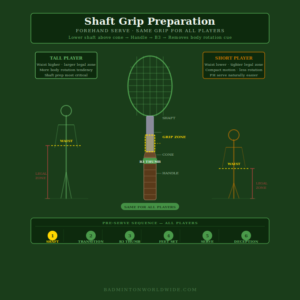
The shaft contact position is straightforward: lower shaft, just above the cone, for every player regardless of height or build. This is not a position that varies — it is a fixed reference point that gives the hand a consistent, neutral starting place before the transition to the handle.
To groove the transition, work through this process away from the court.
Hold the racket lightly at the lower shaft just above the cone. From there, make a single fluid motion to the handle, arriving with your thumb at B3. Do not look at your hand — the transition should be felt, not seen. Check the bevel position after arrival. If the thumb is not at B3, adjust the transition motion slightly and repeat. The goal is a fixed, automatic path from shaft contact to correct bevel every time.
Once the transition is automatic, incorporate it as the first step of your pre-serve routine — lower shaft contact, transition to handle, thumb confirms B3, feet set, serve. The entire sequence should feel unhurried and deliberate, even at pace.
Key reference points during setup:
- Shaft contact always at lower shaft just above the cone — consistent for all player types
- Contact should feel light — fingertip control, not a full grip
- Transition to handle is a single fluid motion, not a two-step adjustment
- Thumb must arrive at B3 without visual confirmation — feel, not sight
- Contact point at serve falls comfortably below the waist without conscious adjustment
Shaft Preparation, Deception, and the Removal of Body Cues
The deception benefit of shaft grip preparation operates on two levels — and together they close almost every window through which a skilled returner might read your serve before it arrives.
The first level is grip setup. A server who goes directly to the handle from a resting position sometimes makes visible micro-adjustments as they search for the correct bevel. An experienced returner watching the server’s hand during setup will notice these adjustments — a slight wrist rotation, a finger repositioning — and may be able to read the grip type before the serve begins. A server who begins with lower shaft contact and makes a single clean transition eliminates this entirely. The hand starts at a neutral position and arrives at the handle in one motion. There is no searching, no micro-adjustment, no tell.
The second level is body rotation. This is the more significant deception gain for most competitive servers, particularly taller ones. A serve preparation that is hand-led and compact — anchored by the shaft contact before transitioning to the grip — naturally suppresses the body rotation that would otherwise precede the swing. The shoulders stay quieter. The weight transfer is less pronounced. The entire setup reads as neutral rather than as the beginning of a forehand motion.
When a returner cannot read the grip and cannot read body rotation, they have no advance information about what is coming. That is the serve deception ceiling — and shaft grip preparation is one of the primary mechanisms for reaching it.
Combined with identical preparation across your low serve, wide push, and flick, shaft grip preparation closes the last remaining windows through which a skilled returner might anticipate your intentions before the shuttle leaves your racket.
Building It Into Your Routine
Shaft grip preparation is not a complex technique. It is a simple addition to the front end of your pre-serve routine that pays returns across every dimension of your serve game — grip consistency, legal contact height management, adaptation to your physical proportions, and deception in setup.
The sequence is straightforward: racket hand contacts shaft → transitions to handle → thumb finds bevel → feet set → shuttle held → serve. That first step costs you nothing in time or complexity. What it gives you is a reliable, repeatable entry point into the serve motion that every other element of your technique can build on.
For players who have struggled with serve consistency without being able to identify why, this is often the missing piece. The swing is fine. The grip is fine in isolation. The problem is in how the grip is found — and shaft preparation is the fix.
Learn the Complete Serving Framework
Grip preparation, bevel positioning, contact point management, and the full forehand and backhand serve mechanics are covered in the Doubles Serve Mastery guide. If serve consistency is the gap in your doubles game, that is where to start.