
The most powerful thing about the flick serve is not the flick itself.
It is the threat of it.
A well-executed flick serve wins a point occasionally. But a credible flick threat — one the returner genuinely believes can arrive at any moment — changes how they stand, how they hold their racket, and how aggressively they can attack your low serve. The threat does more work across a full match than the flick itself ever could.
Understanding how to use the flick threat as a freezing mechanism is one of the most underappreciated tactical skills in competitive doubles serving.
What Freezing the Returner Means
A returner who is not threatened by the flick will stand close to the short service line, hold their racket high, and attack your low serve the moment it crosses the net. They are fully committed forward. Their weight is on their toes. Their read time is short and their attack angle is steep. Against this returner, even a well-placed low serve is difficult to win from — they have optimized their entire return position around the assumption that a low serve is coming.
A returner who believes the flick is coming cannot do this. They must hold slightly deeper to give themselves time to recover backward if the shuttle goes over their head. They cannot commit their weight fully forward. Their racket cannot sit as high without leaving them vulnerable overhead. They are, in the most precise sense of the word, frozen — caught between two positions, committed fully to neither.
That hesitation — that fractional delay in committing to the attack — is exactly what your low serve needs to be effective. You do not need the returner to be off-balance. You need them to be uncertain. Uncertainty is enough.
How the Flick Threat Is Established
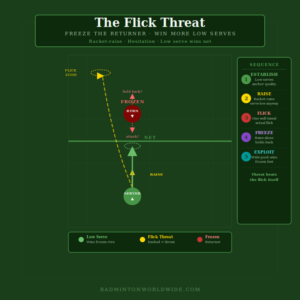
The flick threat is not established by talking about it. It is established by demonstrating it — specifically, by raising your racket in a way that the returner cannot distinguish from your actual flick preparation.
This is the racket-raise sequence. In your pre-serve motion, after setting your grip and before the swing, a brief raise of the racket head — not a full backswing, but a deliberate upward movement that mimics the early stage of a flick — plants the suggestion in the returner’s mind that a flick may be coming. Executed correctly, this gesture is indistinguishable from your actual flick preparation. The returner sees the racket rise and must make an instant decision: hold back for the flick, or commit forward for the low serve.
The racket-raise is not deception for its own sake. It is a communication to the returner that the flick is a live option. Once they have seen it — and particularly once they have been beaten by an actual flick serve — the raise alone is enough to produce the hesitation you need.
The Sequence That Works
The flick threat is most effective when it is sequenced correctly within a service game. Deploying it randomly or too early before the returner has been conditioned reduces its impact. The sequence that consistently produces freezing follows this logic.
First, establish your low serve. Deliver several anchor serves — backhand straight push to the centerline — at high quality. Let the returner get comfortable. Let them move slightly forward. Let them begin to commit.
Second, introduce the racket-raise without delivering the flick. Raise the racket in your pre-serve motion and serve low anyway. The returner hesitates, reads the raise, holds back slightly — and your low serve lands in a slightly better position than it would have against a fully committed returner. The raise has done its work without the flick ever arriving.
Third, deliver the actual flick. Choose a moment when the returner has leaned forward — after a run of low serves, or when their weight is visibly committed. Send the shuttle over their head. When the flick lands, it resets the entire dynamic. The returner now knows the flick is not just a gesture — it arrives. Every subsequent racket-raise carries full credibility.
From that point forward, the raise alone is sufficient to freeze. You may not need to flick again for several games. The memory of the one flick that landed is enough to hold the returner in a compromised position throughout.
Why the Raise Must Come Before the Wide Push
In the Two-Serve System, the racket-raise flick threat is most valuable when it is sequenced before the forehand wide push. Here is why.
A returner who is frozen by the flick threat is already holding slightly deeper and wider than optimal. Their weight is back. Their recovery to the wide sideline is slightly slower. When the forehand wide push arrives in this moment — low, to the wide service box — the returner is already a fraction late in their movement toward it. The wide push lands in a zone they were already slow to cover.
The raise freezes the feet. The wide push exploits the frozen feet. The combination produces a return that is late, lifted, or forced — exactly the quality you want at the start of a rally.
Without the flick threat, the wide push faces a returner who is fully mobile and fully committed to attacking. With the flick threat established, the wide push arrives against a returner who is caught mid-decision. The geometry of the serve has not changed. The returner’s ability to respond to it has.
The Psychological Compounding Effect
The flick threat does not reset between rallies. It accumulates.
A returner who has been beaten by a flick early in the match carries that memory into every subsequent service point. Each racket-raise reactivates it. The hesitation becomes a habit — not a conscious choice, but an automatic response to a gesture they have learned to respect. As the match progresses and the pressure increases, that automatic hesitation becomes more pronounced, not less.
This is the compounding effect of the flick threat. One well-timed actual flick, early in the match, can influence the returner’s position on every single service point for the remainder of the game. The investment in the flick — the practice required to execute it cleanly, the patience required to deploy it at the right moment — pays returns far beyond the point it directly wins.
What the Flick Threat Requires
For the flick threat to function as a freezing mechanism, three conditions must be met.
First, the flick must be technically credible. A flick serve that clips the net or lands mid-court is not a threat — it is a gift. The returner will attack it and learn quickly that your flick is not dangerous. The flick must be able to land deep and flat, close to the back tramline, with enough pace to prevent interception. Without that technical foundation, the threat is empty.
Second, the racket-raise must be indistinguishable from your actual flick preparation. If the raise looks different from your real flick — different height, different wrist position, different timing — experienced returners will read it as a fake and ignore it. The raise only works if it is genuinely ambiguous.
Third, the flick must be delivered at least once early enough in the match to establish its credibility. A threat that is never acted on loses its power. The returner will eventually test it — leaning forward to attack your low serve — and when no flick arrives, the freeze breaks. Use the actual flick sparingly but certainly.
Practical Application: What to Do in Your Next Match
In your next competitive doubles match, try this sequence deliberately.
In the first three service games, serve low exclusively. Establish the anchor serve quality. Let the returner settle into their forward return position.
In the fourth or fifth service game, introduce the racket-raise on two or three serves without delivering the flick. Watch for the hesitation. If you see the returner hold back slightly, the raise is working.
Then deliver one actual flick — clean, deep, flat — at a moment the returner has leaned forward. Let it land. Note the adjustment they make.
For the remainder of the match, the raise alone will hold them. Use the wide push in the moments immediately following a raise. Your low serves will land against a returner who is no longer fully committed to attacking them.
The Serve Is a Mind Game First
The best doubles servers understand that the physical execution of the serve is only half the battle. The other half is managing what the returner believes is coming. The flick threat — established through the racket-raise, confirmed by one well-timed actual flick, and maintained through deliberate sequencing — is the mechanism that gives your low serve the space it needs to be effective.
You do not need to flick often. You need the returner to believe you might.
Build Your Complete Serving Arsenal
The flick threat, the racket-raise sequence, and the full Two-Serve System framework are covered in detail in the Doubles Serve Mastery guide. If you want to own the serving conversation in competitive doubles, that is your next step.